Project Based Learning, or PBL, is often seen as an approach that can make learning more alive. Students do not simply receive information. They investigate problems, discuss ideas, create products, present their work, and reflect on their learning process.
However, for teachers, implementing PBL is not just about assigning a project. Teachers need to design the workflow, break the project into stages, monitor student progress, connect activities with learning objectives, assess the process, and prepare learning progress reports. When all of this is managed manually, PBL can easily shift from meaningful learning into an administrative burden.
For this reason, Project Based Learning needs to be supported by a clear workflow, a structured management system, and a reporting process that helps teachers understand student progress more holistically.
Project Based Learning as Meaningful Learning
Project Based Learning is a teaching method that allows students to learn through active engagement in real-world and meaningful projects. In PBL, students work over an extended period of time, from one week to one semester, to investigate and respond to an authentic, engaging, and complex question, problem, or challenge (PBLWorks, n.d.).
This means PBL is not simply about creating a product after the lesson is finished. Strong PBL places the project at the center of learning. The project becomes the vehicle for students to understand concepts, develop skills, and demonstrate their understanding through both the process and the final product.
Not every project-based task automatically becomes Project Based Learning. In practice, some projects only appear as additional assignments after the main lesson has been completed, so students simply create a product at the end. High-quality PBL places the project at the core of the learning process: students build conceptual understanding, explore ideas, receive feedback, engage in assessment, and reflect within the project workflow itself (PBLWorks, n.d.).
Through this process, students do not only remember information. They use knowledge to solve problems, make decisions, collaborate with others, and communicate ideas.
Building More Contextual Learning
PBL is relevant because students need to learn how to deal with situations that are more complex than ordinary exercises. They need to connect knowledge with real-world contexts, work with others, process information, and produce solutions they can explain.
PBL supports the development of skills such as collaboration, problem solving, information gathering, time management, communication, and the appropriate use of technology (Edutopia, 2007). These skills are difficult to develop fully when learning only focuses on receiving information and completing individual exercises.
Based on a meta-analysis conducted by Zhang and Ma (2023) involving 66 experimental and quasi-experimental studies, Project Based Learning has been shown to make a positive contribution to student learning outcomes. These outcomes include academic achievement, affective attitudes, and thinking skills. However, the effectiveness of PBL is also influenced by several factors, such as education level, group size, class size, project duration, and subject area (Zhang & Ma, 2023).
This finding is important because it shows that PBL does not automatically succeed simply because teachers assign a project. Its impact depends greatly on how the project is designed, implemented, monitored, and assessed. In a broader learning context, teachers can also explore the key reasons why Project Based Learning is important to implement so that PBL is not seen merely as a variation of assignments, but as an approach that helps students learn more actively and meaningfully.
The Main Challenge of PBL Lies in Management
Conceptually, many teachers understand the benefits of PBL. The challenge appears when PBL has to be implemented in the day-to-day reality of the classroom.
In one project, teachers need to ensure that students understand the problem, follow the stages of work, collect evidence of learning, receive feedback, revise their work, and produce a final product. If the project is done in groups, teachers also need to observe each student’s contribution. If the project runs for several weeks, teachers need to keep the process moving and prevent it from losing momentum.
Several challenges commonly arise.
First, project stages are not always clear.
Students may know that they need to create a final product, but they may not fully understand the process required to get there. As a result, some students immediately create the product without doing enough research, while others are unsure how to begin.
Second, student progress is difficult to monitor.
In PBL, each student or group may be at a different stage. Some may already be revising their work, some may still be collecting data, and others may not yet understand the problem. If teachers only rely on manual notes, this kind of progress can easily be missed.
Third, evidence of learning is scattered.
Project evidence can take many forms: observation notes, photos, documents, videos, drafts, reflections, or presentations. When these are stored in different places, teachers need extra time to bring them together. Yet this evidence is important for understanding student development over time. For this reason, learning documentation in PBL should not only function as an archive of tasks, but can also be connected to a digital Student Portfolio that helps teachers monitor student growth more continuously.
Fourth, the connection between the project and learning objectives is not always visible.
A project may look active and engaging, but it does not always show clear learning outcomes. Teachers still need to ensure that every activity is connected to the intended learning objectives or learning outcomes.
Fifth, reporting becomes additional work.
After the project is completed, teachers still need to process progress data, scores, evidence, and notes into reports that can be understood by students, homeroom teachers, school leaders, or parents.
For this reason, PBL requires a management system that helps teachers understand the learning process, not only the final product.
Manual Management Is Often Not Enough
Spreadsheets, shared documents, digital folders, and teachers’ personal notes can be helpful at the beginning. However, when a project runs through several stages and involves many students, manual management is often not enough.
Teachers need to see several things at once: which stage students are working on, who has submitted their work, who needs support, which learning objectives are being addressed, and what evidence has already been collected. When this information is scattered, teachers spend too much energy managing administration instead of supporting the learning process.
In PBL, assessment should not only happen at the end of a project. Teachers need to understand student progress throughout the process, from how students conduct research, collaborate, develop ideas, receive feedback, and revise their products. Through staged assessment, teachers can understand student ability more holistically, not only from the final product they submit (Edutopia, 2007). To prevent this process from creating repetitive administrative work, teachers also need a more efficient way to manage student assessment results without additional workload.
In addition to assessment, reflection is also an important part of PBL. Students need to receive feedback during the project process, recognize their strengths, and understand areas that still need improvement. In this way, the project does not only produce a final product, but also helps students become aware of their learning development over time (CCE Finland, 2025). This reflective process can be strengthened through Learning Journey, so students do not only complete the project, but also learn to understand their own learning growth.
Therefore, PBL requires a workflow that makes it easier for teachers to monitor the process continuously. It should not only be a place to store assignments, but a system that helps teachers see learning development over time.
Managing PBL More Effectively and Efficiently
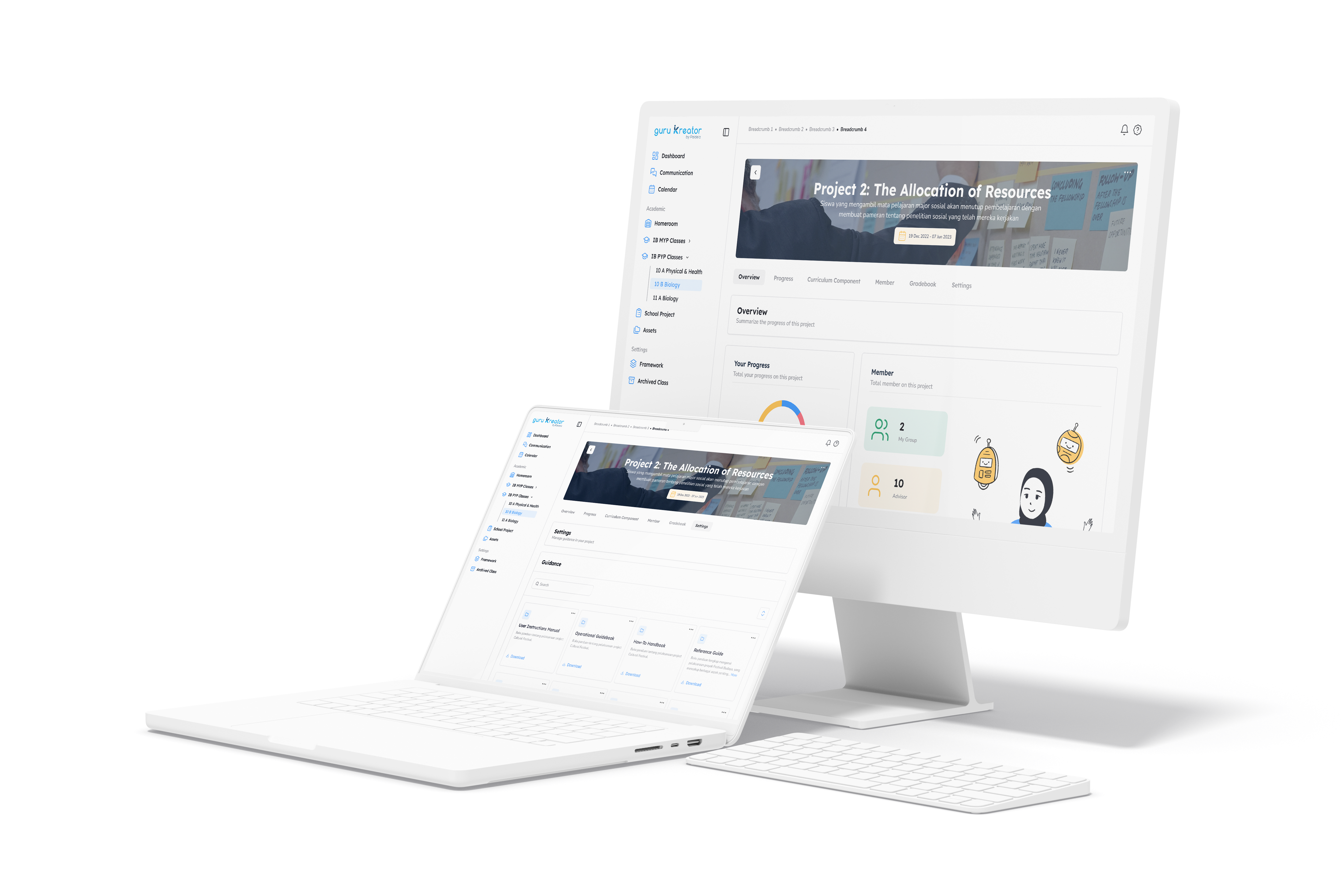
Project Guru Kreator is designed to help teachers manage project-based learning in a more structured workflow. Through this feature, teachers can create staged assignments, monitor the progress of individual students or groups, connect project activities with learning objectives, and generate learning progress reports.
With Project PBL no longer has to depend only on manual notes or scattered documents. Teachers have a workspace that helps them manage the project process from beginning to end.
This feature can be used for small classroom projects, cross-subject projects, grade-level projects, and larger school-wide projects. For co-curricular activities, Project can also help schools manage projects that require clearer workflows, documentation, assessment, and reporting.
Project does not replace the teacher’s role in designing learning. Teachers still determine the context, driving questions, activities, rubrics, and quality of facilitation. However, the Project feature helps reduce administrative workload so teachers can focus more on supporting students.
Managing PBL to Be More Staged, Measurable, and Documented
1. Projects become more staged and easier to follow
One reason PBL can feel overwhelming is that projects are often given as one large assignment. Students are asked to create a final product, but they are not always given a clear workflow.
Through Project teachers can break a project into several stages, such as:
- understanding the problem;
- conducting observations;
- collecting data;
- developing solution ideas;
- creating a draft or prototype;
- receiving feedback;
- revising the work;
- presenting the result;
- writing a reflection.
These stages help students understand the work process they need to go through. For teachers, the stages also make monitoring easier because progress is not only seen from the final product, but from every step of learning.
2. Assignments can be organized for individuals or groups
In PBL, teachers often need to differentiate between individual and group workflows. Some tasks are completed collaboratively, while others need to show each student’s personal understanding.
Project allows teachers to assign tasks to individual students as well as groups of students. This helps teachers maintain a balance between collaboration and individual responsibility.
For example, in an environmental campaign project, a group may conduct research and create the product together. However, each student can still have an individual reflection, contribution note, or specific task that shows their own understanding.
3. Projects stay connected to learning objectives
Good PBL does not only produce an interesting product. A project needs to show clear learning outcomes.
Through Project teachers can determine the learning objectives or learning outcomes to be achieved in the project. This allows every project stage to remain connected to the planned direction of learning.
For elementary school, projects can focus on simple observations, communication, and reflective habits. For middle school, projects can begin to involve data analysis, collaboration, and presentations. For high school, projects can be developed into research, solution proposals, interdisciplinary products, or public presentations.
This approach is flexible across grade levels because what is being managed is not only the final product, but also the learning process and outcomes.
4. Student progress can be monitored before the project ends
In PBL, teachers need to understand student progress before the project is finished. If teachers only see the results at the end, opportunities to provide support during the process become limited.
Project helps teachers monitor the progress of students or groups at each stage. Teachers can see who has completed a specific part, who has not yet moved forward, and which areas may need intervention.
This is important because meaningful PBL requires continuous feedback. The effectiveness of PBL is influenced by design and implementation conditions, so monitoring the process becomes an important part of ensuring that the project does not merely run, but truly supports learning (Zhang & Ma, 2023).
5. Learning progress reports become easier to prepare
Reporting is often one of the most time-consuming parts of PBL. Teachers may have many notes and pieces of learning evidence, but they still need to turn them into information that is easy to understand.
Project helps teachers generate reports that can be used to understand student development. These reports can help teachers explain progress, achievements, and areas that still need improvement.
With more structured reporting, teachers can more easily communicate student development to homeroom teachers, school leaders, parents, or students themselves.
The Meaning of PBL Is Still Built Through the Teacher’s Role
Project helps manage PBL, but it does not automatically make a project meaningful. Meaningful learning is still built through the teacher’s design and facilitation.
Teachers remain the main designers and facilitators of learning. They determine relevant problems, develop driving questions, organize learning experiences, build a culture of collaboration, provide feedback, and support student reflection.
Technology helps make the process more organized. However, the quality of learning is still determined by how teachers guide students to think, collaborate, try, receive input, and improve their work.
For this reason, Project should be understood as a support for learning transformation. This feature helps teachers reduce administrative work, keep the project workflow visible, and make student progress easier to understand.
Project Supports More Directed and Documented PBL
Project Based Learning can help students learn in a more active, contextual, and meaningful way. However, PBL needs strong management so it does not become a busy project assignment with learning outcomes that are difficult to read.
Good PBL needs clear learning objectives, structured stages, documented learning evidence, ongoing assessment, and accessible reporting.
Project helps teachers manage these needs in one workflow. Teachers can design staged projects, organize individual and group tasks, connect activities with learning objectives, monitor progress, and generate student learning progress reports.
With this support, teachers can focus more on what matters most: guiding students to think, collaborate, try, revise, and understand their own learning process.
If your school would like to see how Project can support the implementation of Project Based Learning across grade levels, contact us to get a free demo.
References
CCE Finland. (2025, March 10). Project-based learning: Fostering critical thinking and collaboration in education. CCE Finland. https://www.ccefinland.org/post/project-based-learning-fostering-critical-thinking-and-collaboration-in-education
Edutopia. (2007, October 19). Why is project-based learning important? The many merits of using project-based learning in the classroom. https://www.edutopia.org/project-based-learning-guide-importance
PBLWorks. (n.d.). What is project based learning? Buck Institute for Education. https://www.pblworks.org/what-is-pbl
Zhang, L., & Ma, Y. (2023). A study of the impact of project-based learning on student learning effects: A meta-analysis study. Frontiers in Psychology, 14, Article 1202728. https://doi.org/10.3389/fpsyg.2023.1202728