Helping Students See Their Own Learning Progress: The Role of Learning Journey in Student Portfolio
Every day, teachers face similar questions from students and parents: “How is my learning progress?” This question is often answered in traditional ways through report card grades at the end of the semester, brief notes in the report book, or parent-teacher meetings limited to just a few minutes. Parents want to know more deeply about how their child is developing. Teachers recognize that students need to understand their own progress to take an active role in learning. However, without clear and comprehensive visualization, this understanding is difficult to achieve.
Meanwhile, many students still feel that learning is a compartmentalized activity. Lessons follow lessons and exams follow exams without a connecting thread that links all learning experiences into one meaningful narrative. Students do not always realize that every assignment, every quiz, and every project is part of a larger learning journey.
Why Traditional Methods Are Not Effective Enough
Effective portfolios require clear alignment with specific learning standards and objectives. However, traditional progress documentation systems often fail to provide a holistic view of student growth.
The first problem is fragmentation of learning data. Information about student progress is scattered in various places such as assessment documents, class notes, task files, and emails. There is no single place that integrates all this data into one cohesive learning story.
The second problem is the lack of student involvement in the progress documentation process. Students who actively monitor their own progress (for example, by creating grade graphs or tracking books they have read) begin to take ownership of their learning. However, many traditional systems do not provide this opportunity. Students become passive recipients of information rather than active partners in understanding their progress.
The third problem is limited self-awareness. The ability to evaluate how one thinks and learns helps students develop an understanding of their own strengths and weaknesses, as well as the strategies most useful in particular situations. Without proper visual and reflective tools, students cannot fully develop this awareness. Therefore, an effective progress documentation system is not just about collecting data but about empowering students to understand themselves as learners.
From Traditional Assessment Toward Student Ownership-Based Learning
Rather than viewing student progress as a series of separate grades and information given to students, there needs to be a fundamental paradigm shift. Learning should move toward a model where students are active owners of their own learning journey.
In the student ownership approach, students do not merely serve as learning participants but as individuals who actively understand, manage, and reflect on their own learning development. Students choose meaningful experiences to document, articulate the processes and meanings of their learning experiences, and use reflection and learning data to set goals and determine their next learning steps. In this approach, teachers serve as facilitators who accompany students in building awareness and ownership of their learning journey (Sakai & Bakke, 2022).
This is a shift from traditional assessment, where teachers assess students, toward student ownership-based learning, where students own and guide their own learning.
Learning Journey in Student Portfolio
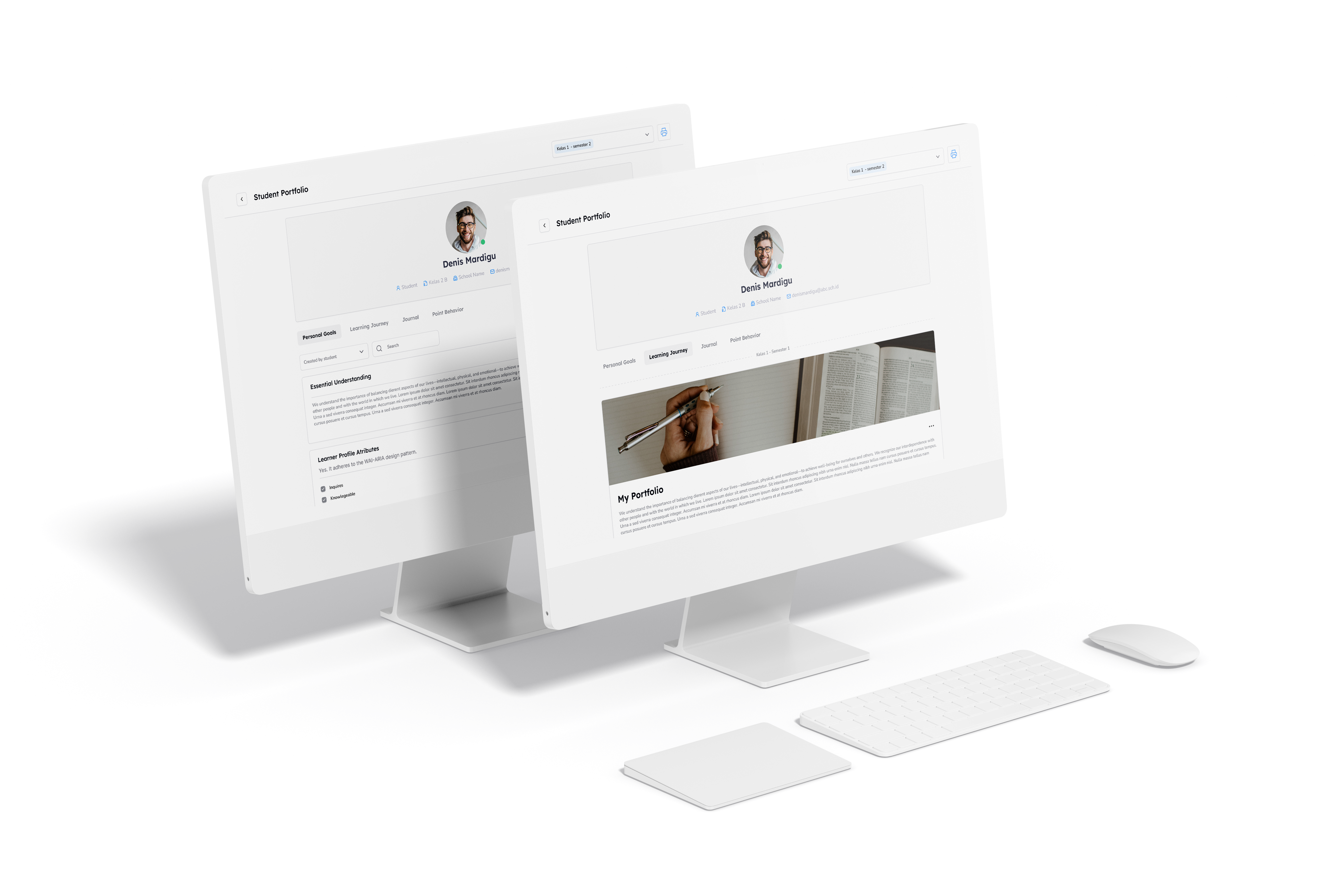
Learning Journey is a feature in Guru Kreator specifically designed to realize this meaningful learning approach. This feature functions as an integrated documentation system that empowers students to take full ownership of their learning by providing them with the space, tools, and structure to tell, reflect on, and monitor their own learning journey.
Learning Journey allows students and teachers to document, monitor, and reflect on learning progress over time.
How Learning Journey Works
The process of using Learning Journey is simple yet meaningful. Most importantly, it is students who guide the process themselves.
Documenting the Beginning — Students document their initial abilities and understanding at the start of the learning period. This provides a clear picture of their starting point.
Adding Learning Experiences — Throughout the learning period, students actively choose and add meaningful learning experiences into their portfolio. It is not the teacher who chooses but students who decide what is important to document and why.
Telling Progress — Students periodically write narratives about their progress in their own words. They connect learning activities with what they have learned and how they feel about this growth.
Recording Achievements — Students collect and document their own achievements. These can be new skills, deeper understanding, or other important milestones.
Continuous Reflection — Students reflect on their entire learning journey, identify learning patterns, and set their own next learning goals.
Differentiation of Learning Journey from Other Tools
Learning Journey is not just a grade documentation tool. It is a space where students become owners of their learning. Unlike traditional report cards where teachers tell students about their progress, Learning Journey empowers students to tell, understand, and lead their own learning. Students use their own data to make decisions about their learning.
Digital portfolio data provides dynamic evidence of student learning processes. This helps teachers understand deeply and enables students to identify patterns and areas for improvement in a proactive, not reactive, manner.
With Learning Journey, students become writers, analysts, and navigators of their own learning story. This is true empowerment.
The flexibility of this feature means Learning Journey can be customized to specific needs. It is not limited to subject documentation alone but can include meaningful cross-curricular learning experiences that matter to students and align with their personal learning goals.
What Becomes Easier and Better
Benefits for Students
True Student Ownership — When students take ownership of their learning documentation, narratives, and reflections, they do not just receive learning but own it. Students become active agents in their learning journey, making decisions about what to learn, how to learn, and where they will go next. This sense of ownership transforms learning from something done to students into something done by students.
Deeper Self-Awareness — When students participate in selecting and telling their learning experiences, they engage in critical thinking about their own learning and growth. This process helps students develop deep awareness of their strengths and areas that need improvement. They learn to become observers of how they learn and can identify strategies that work for them.
Increased Motivation — Students who see real progress and feel they own their learning tend to be more intrinsically motivated. Learning with full ownership can significantly increase student motivation. Motivation no longer comes from grades or teacher decisions but from students’ own awareness of their progress.
More Meaningful Learning — Rather than viewing lessons as separate, unconnected activities, students begin to see how everything connects in one coherent and meaningful learning journey. When they themselves tell these connections, learning becomes more personal and relevant.
Development of 21st Century Skills — When students consistently document, reflect on, and evaluate their own learning, they develop important abilities: the ability to monitor their own progress, identify areas for growth, and take action based on data and reflection. These skills form the foundation of independent learning in the future.
Benefits for Teachers
More Comprehensive Understanding — Rather than just seeing grade numbers in a spreadsheet, teachers can see learning patterns, narratives of student growth, areas needing more support, and the pace of progress for each student individually.
More Meaningful Conversations — Regularly scheduled portfolio conferences between teacher and student make the assessment process more personal and effective. Teachers can focus on growth and ownership, not just grades.
Differentiated Instruction — By viewing students’ Learning Journey, teachers can tailor their teaching approach to meet each student’s specific needs and respect students’ ownership of their learning.
Authentic Documentation — Teachers have real evidence of what students have learned and how students view their own learning. This information is valuable for reports to parents and planning for next learning experiences.
Benefits for Parents
Real Transparency — Instead of just receiving a report card, parents can see concrete evidence of what their child is learning and how they are developing through their child’s own words.
Better Engagement — With more detailed and understandable information, and seeing their child’s ownership of their learning, parents can more actively support their child’s learning at home. Parents become partners in supporting their child’s student ownership. Parents can learn more about how they can monitor and support their child’s learning through digital platforms.
Deeper Conversations — Data from Learning Journey enables richer conversations between parents and children about learning, not just about grades.
Practical Implementation
To maximize the benefits of Learning Journey and support student ownership, consider the following:
Stage 1: Planning — Identify main learning objectives and discuss with students about their own learning goals. Establish a regular schedule for adding learning experiences and reflection.
Stage 2: Documentation — Students select and add various types of meaningful learning experiences into their Learning Journey.
Stage 3: Reflection — Encourage students to regularly reflect on their progress and use this reflection to set their own next learning goals.
Stage 4: Communication — Share Learning Journey with parents regularly and use it as a basis for more meaningful conversations in parent-teacher conferences.
The First Step Toward Student-Owned Learning
Learning Journey in Guru Kreator’s Student Portfolio is not just an additional feature. It is a philosophical shift about who owns and guides learning. Rather than treating learning as a series of separate snapshots evaluated by teachers, Learning Journey empowers students to become owners and leaders of their own learning journey.
When students understand their own progress, when they become writers of their learning story, when they use data about themselves to make decisions about their learning, they do not just learn content. They learn to become self-aware, motivated, independent learners who have full ownership of their learning. They learn that learning belongs to them, not to teachers or parents. That is the true power of Learning Journey.
Start Empowering Your Students Today
Ready to change how your students see their learning? Learning Journey in Guru Kreator’s Student Portfolio makes student ownership not just a concept but a daily reality in your classroom.
Explore Guru Kreator’s Student Portfolio feature now and see how Learning Journey can transform your students’ learning experience. Begin the journey toward more meaningful, student-centered learning today.
Contact the Guru Kreator team to schedule your free demo!
Reference
Sakai, R., & Bakke, C. (2022). Student ownership of learning: A student’s experience. In M. Jones (Ed.), Proceedings of InSITE 2022: Informing Science and Information Technology Education Conference (Article 23). Informing Science Institute. https://doi.org/10.28945/4992